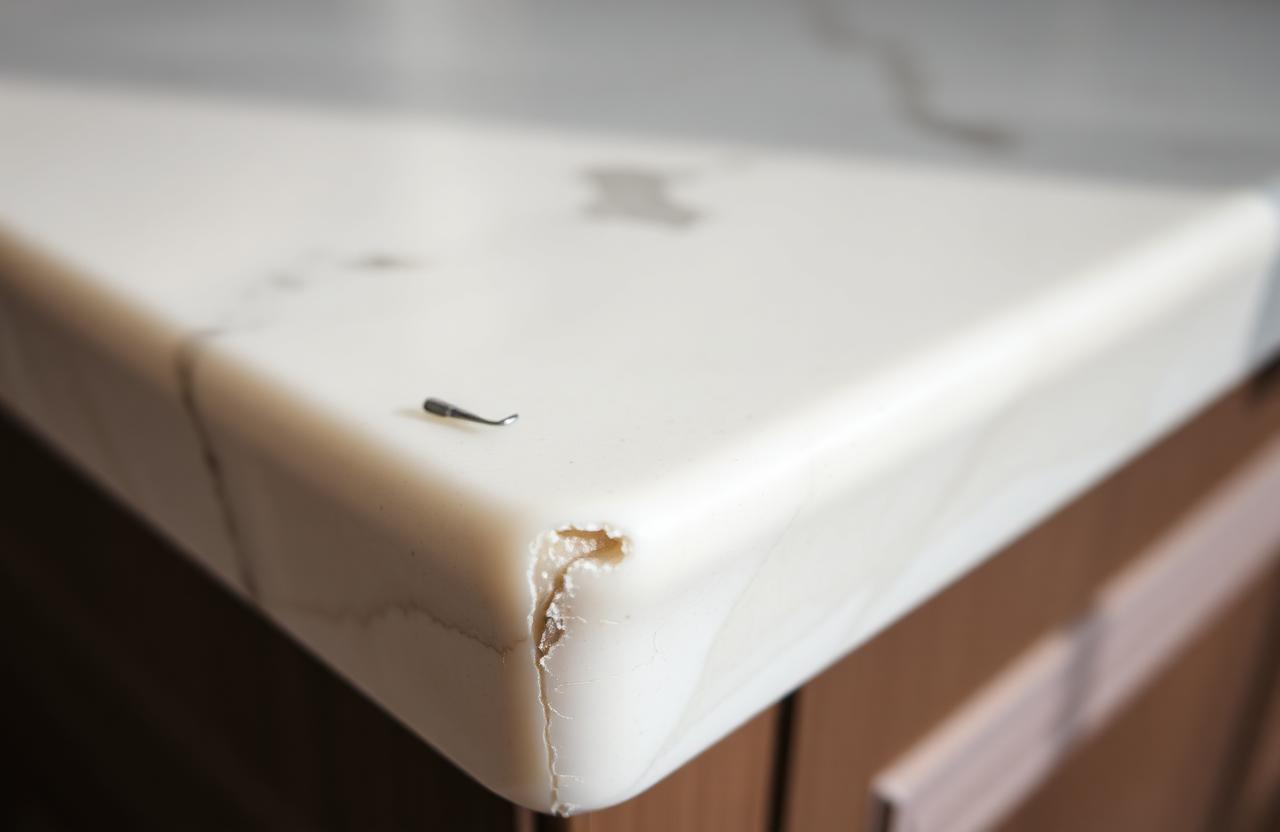
Chipped edge
A missing piece of stone, usually at an edge or corner.
How to spot it
- A missing fragment, usually at an edge or corner
- Sharp, fresh edges if recent — duller if older
- Sometimes accompanied by a hairline crack running inward
Often confused with
Pit
A pit is a small natural void; a chip is a fresh break with sharper edges.
Crack
Cracks run as lines; chips are missing material.
What causes it
Impact from heavy objects or accidental knocks.
How to repair it
DIY fix
Call a pro 30–60 minutes plus 24-hour cure
You'll need
- Color-matched stone epoxy kit
- Plastic putty knife
- Painter's tape
- Razor blade
- Polishing pad (optional)
- 1Save the chip if you can find it — it gives the cleanest repair.
- 2Clean and fully dry the chipped area.
- 3Tape around the chip to keep epoxy off the surrounding surface.
- 4Mix the epoxy and tint to match — test a tiny dab nearby first.
- 5Press epoxy into the gap, slightly proud of the surface.
- 6Let cure 24 hours, then razor off the excess level with the surface.
- 7Optionally polish with a fine pad to blend the sheen.
Pro fix
- When to call
- Visible chips on a feature edge, large missing pieces, or chips on engineered quartz.
- Typical cost
- $200–$800 depending on visibility and size
- What they'll do
- Custom-tint multi-layer epoxy, sculpt the missing profile, then refinish to match the surrounding edge.
Do NOT use on this damage
Super glue
Yellows over time and won't fill volume — only bonds tiny fragments.
Wood filler
Different texture, won't bond to stone, looks obviously wrong.
White silicone
Stays soft, collects grime, and reads as a repair from across the room.
Prevent it next time
- Add an edge profile (eased or bullnose) — sharp 90° edges chip easily.
- Be careful with cast-iron pans near the edge.
- Tighten cabinet doors that swing into the counter overhang.
Always test any product on a small, hidden area first. Cost ranges are general estimates and vary by region and stone.