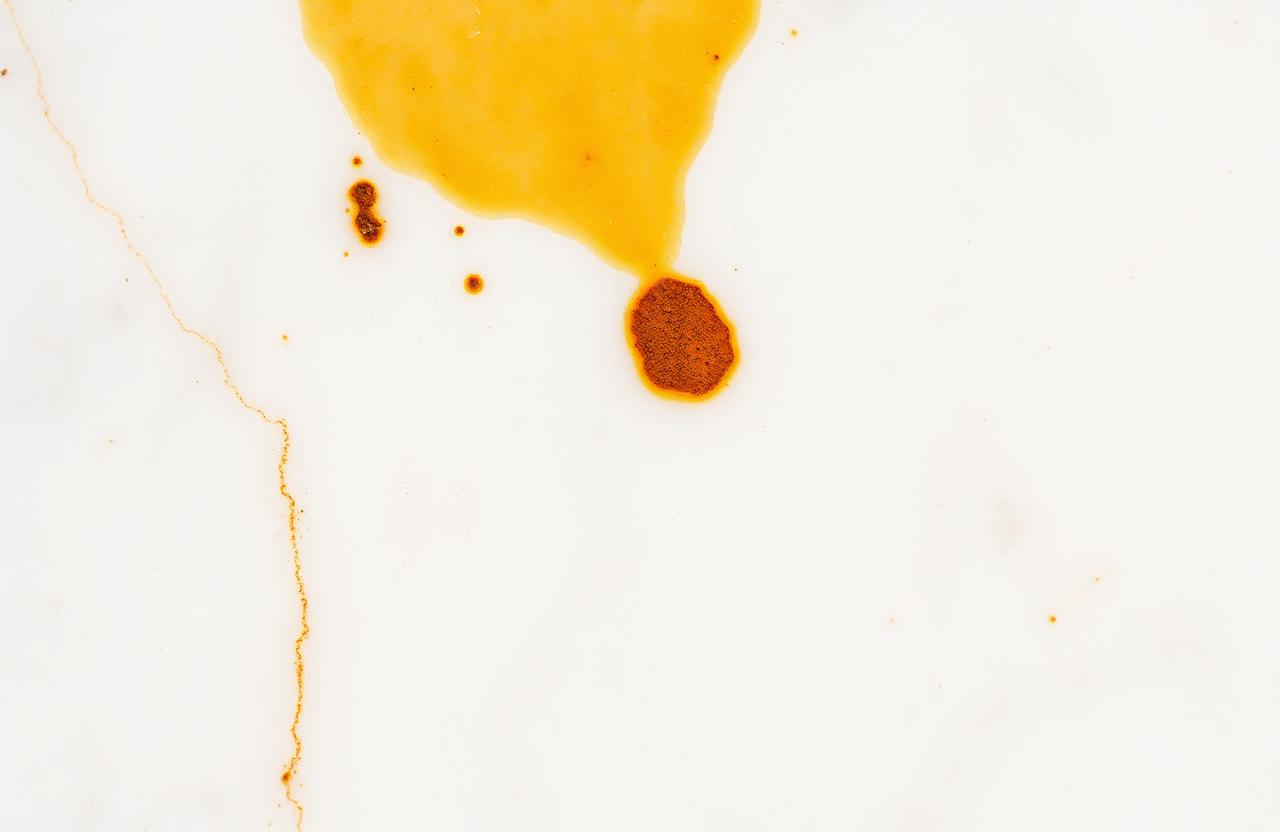
Rust stain
An orange or brown discoloration, often around metal objects left on the stone.
How to spot it
- Orange, yellow-brown, or red-brown discoloration
- Often shaped like the metal object that caused it (can ring, hairpin)
- Doesn't lift with poultices for organic stains
Often confused with
Iron in the stone
Natural iron deposits darken evenly across a vein, not in a localized spot.
Tea or coffee stain
Brown but not orange; lifts with a hydrogen-peroxide poultice.
What causes it
Iron oxidizing from cans, cast-iron pans, bobby pins, or naturally occurring iron deposits in the stone.
How to repair it
DIY fix
Call a pro 1–3 days per pass
You'll need
- Stone-safe rust remover (gel)
- Plastic spatula
- Distilled water
- Microfiber cloth
- 1Verify the product is labeled safe for your stone — most rust removers are not.
- 2Apply a thin layer per the manufacturer's directions.
- 3Cover and leave for the listed dwell time (often 12–24 hours).
- 4Remove gently, rinse thoroughly with distilled water, and dry.
- 5Repeat up to two more times — stop and call a pro if no progress.
Pro fix
- When to call
- Stain is large, deep, on a feature stone, or DIY product made it worse.
- Typical cost
- $250–$700 depending on severity
- What they'll do
- Apply a controlled chelating compound, sometimes followed by re-honing and resealing.
Do NOT use on this damage
Generic rust remover (CLR, Naval Jelly)
Acid-based — etches and discolors stone instantly.
Bleach
Doesn't break down rust and can leave its own mark.
Steel wool
Leaves new iron particles that rust into fresh stains.
Prevent it next time
- Don't leave cans, cast-iron pans, or hairpins on the stone.
- Dry the surface after cleaning so iron tools nearby don't oxidize onto it.
- Reseal so iron-bearing water can't soak in.
Always test any product on a small, hidden area first. Cost ranges are general estimates and vary by region and stone.